
Struggling with ActiveCampaign login? This ultimate 2026 guide covers fast sign-in methods, SSO setup, two-factor authentication, password resets, and common login fixes — all in one place.
You didn’t sign up for ActiveCampaign to stare at a login screen. You signed up because you want to send emails that actually convert, build automations that run while you sleep, and stop manually following up with every single lead. So when something as basic as logging in starts eating your time? That’s genuinely annoying, and we’re fixing it today.
This guide covers everything — the standard login, SSO options, 2FA setup, password resets, common errors, and how to handle multiple accounts without losing your mind. Grab a coffee. Let’s go.
First Things First — How the ActiveCampaign Login Actually Works
If you’re new to the platform, the login flow is refreshingly simple. No weird onboarding hoops to jump through.
Here’s what you do:
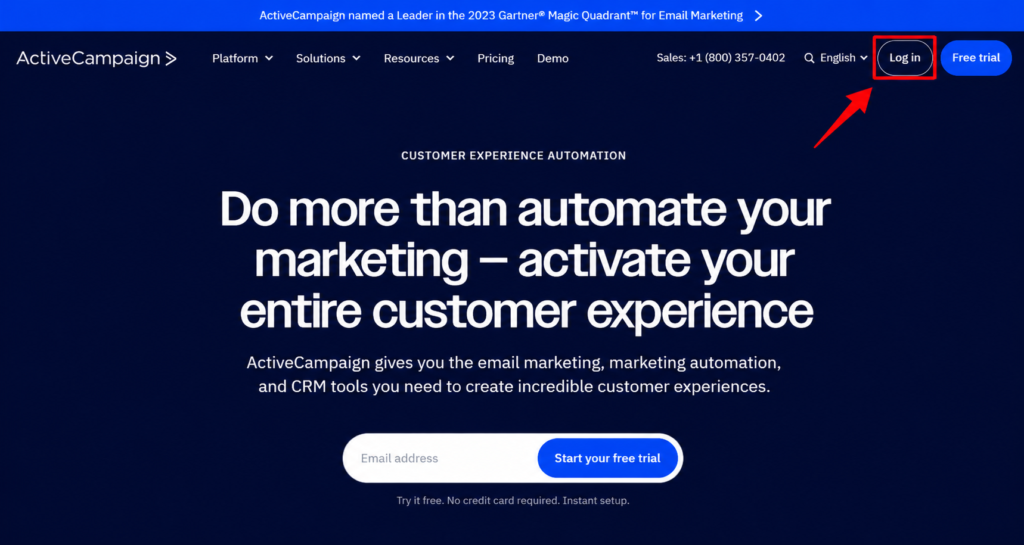
- Go to activecampaign.com
- Hit the Login button — top-right corner, can’t miss it
- Type in your registered email and password
- Click Sign In
That’s genuinely it. You’re in.
One small thing that saves a surprising amount of time — bookmark your direct account URL. It usually looks something like youraccountname.activehosted.com/login. Once you have that bookmarked, you skip the homepage entirely and land straight at your login screen. Takes two seconds to set up and you’ll use it every single day.
The Different Ways You Can Log In (2026)
This is where it gets interesting. ActiveCampaign has expanded their login options quite a bit, and depending on how your team is set up, some of these will make your life dramatically easier.
| Login Method | Available | Works Best For |
|---|---|---|
| Email + Password | ✅ | Everyone — the default |
| Google SSO | ✅ | Google Workspace users |
| Microsoft SSO | ✅ | Microsoft 365 teams |
| Magic Link | ✅ | Passwordless, quick access |
| Two-Factor Authentication | ✅ | Anyone who values their data |
IMO, if your whole team runs on Google Workspace, SSO is the move. One click from the login screen, no password to remember, no “wait, which password did I use for this?” moments.
Logging In With Google or Microsoft SSO
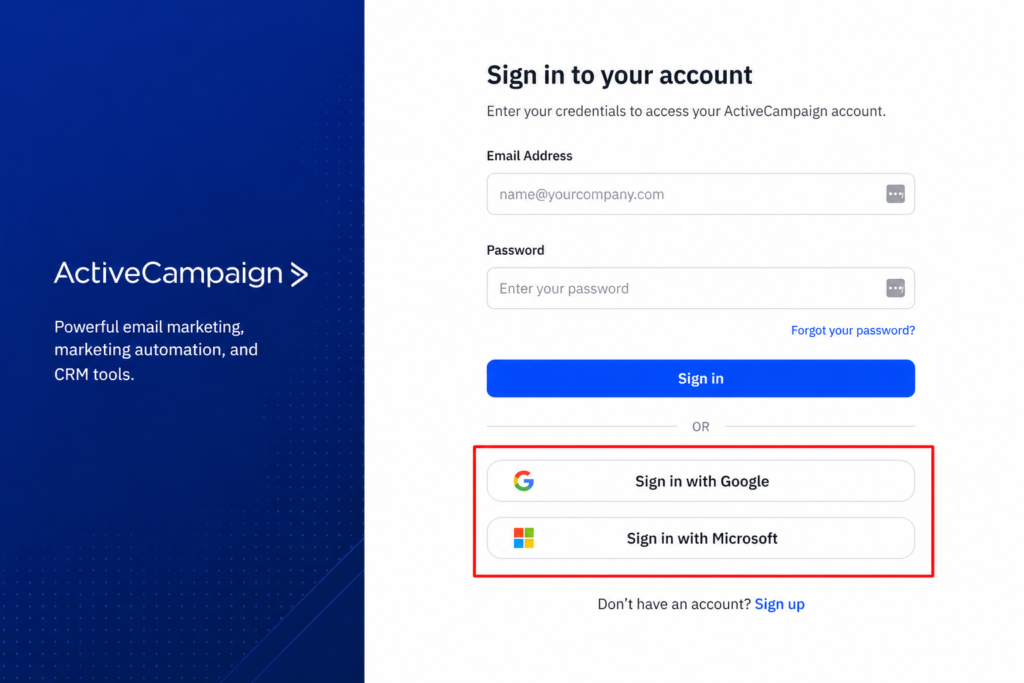
Google SSO
Click “Sign in with Google” on the login page. A pop-up appears, you pick your Google account, you grant permissions the first time around, and that’s it — you’re in. Future logins are a single click.
Microsoft SSO
Same idea. Click “Sign in with Microsoft”, authenticate through your Microsoft account, and you land directly in your dashboard. If your organization manages access through Microsoft 365, this keeps everything consistent and auditable from one place.
One thing to get right here: your Google or Microsoft email must exactly match the email on your ActiveCampaign account. Not “close enough” — exactly. A single extra dot or a different domain alias will throw an error every time. Worth double-checking before you assume something’s broken.
Two-Factor Authentication — Set It Up, No Excuses
Here’s something I’ll say plainly: your ActiveCampaign account holds your full contact database, your automations, your billing details, and probably your business’s most valuable marketing assets. Not protecting that with 2FA in 2026 is just asking for trouble.
Setting it up takes about three minutes.
How to Turn On 2FA
- Log into your account
- Click your profile picture or initials in the top-right corner
- Go to My Settings
- Find Two-Factor Authentication and click enable
- Choose an authenticator app (Google Authenticator, Authy, or 1Password all work)
- Scan the QR code with the app
- Enter the six-digit code to confirm it’s working
- Save your backup codes somewhere safe — not in your email drafts, not in a sticky note on your monitor
A quick note on why you should use an authenticator app over SMS: NIST’s digital identity guidelines have flagged SMS as the weaker option because of SIM-swapping attacks, where someone tricks your carrier into transferring your number to their device. An authenticator app doesn’t have that vulnerability because the codes are generated locally on your phone. FYI — this isn’t an edge case anymore. It happens to real people.
Forgot Your Password? Here’s the Reset Flow
We’ve all been there — logged in twice a week for a year, then took a two-week break and came back to a complete blank. Happens to everyone.
Here’s how you get back in:
- Click “Forgot Password?” on the login page
- Enter your email address
- Check your inbox — the reset email usually arrives within a minute or two (check spam if it doesn’t show up)
- Click the reset link and create a new password
- Log back in
A few things to keep in mind:
- The reset link expires — don’t let it sit for hours before you click it
- Pick a password that’s at least 12 characters and includes numbers and symbols
- If you’re reusing the same password across multiple platforms, that’s a habit worth breaking — a password manager like Bitwarden (free) or 1Password takes the pain out of managing unique passwords for everything
Common Login Issues and How to Actually Fix Them
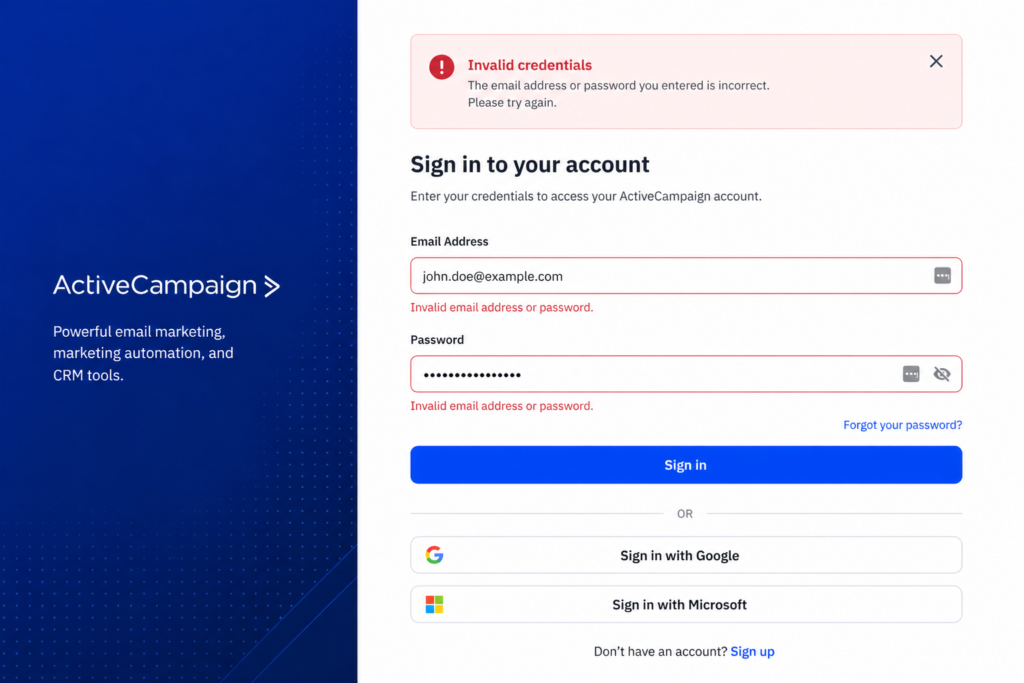
“Invalid Email or Password”
Before you reset anything, run through the basics:
- Check that Caps Lock isn’t on
- Make sure you’re typing the email you actually registered with (not a secondary address)
- Try copying and pasting your password from your password manager to rule out typos
If none of that works, go through the password reset flow above. It’s faster than troubleshooting further.
Account Locked Out
After several failed attempts in a row, ActiveCampaign temporarily locks the account as a security measure. Give it 15–30 minutes before trying again. If it’s still locked after that, contact ActiveCampaign support — they can sort it out quickly.
SSO Not Working
Three things to check:
- Does the email on your Google or Microsoft account exactly match the one on your ActiveCampaign account?
- Has your organization’s IT admin changed any SSO configurations recently?
- Clear your browser cache and cookies, then try again from a fresh session
Nine times out of ten, the email mismatch is the culprit.
2FA Code Keeps Getting Rejected
This one trips people up. Authenticator apps generate codes based on the current time, which means if your phone’s clock is even slightly off, the codes won’t match. Go into your phone settings, make sure time is set to automatic/network time, and try again. Fixes it almost every time.
Logging In on Mobile
ActiveCampaign has a mobile app for both iOS and Android, and it’s genuinely useful for checking campaign performance when you’re away from your desk. The login process mirrors the web version — email and password, or SSO if you’ve set it up.
Once you’re in, you can enable Face ID or fingerprint login from the app settings, which makes future logins take about half a second. Worth turning on.
A few honest notes on the mobile app: it gives you a solid overview of contacts, campaign stats, and basic automation info. It’s not the full desktop experience — you won’t be building complex automations from your phone — but for quick check-ins, it does exactly what you need it to do.
Managing Multiple ActiveCampaign Accounts
If you’re running campaigns for multiple businesses, or you’re an agency managing client accounts, you’ve probably already hit the friction of switching between logins. Here’s the cleanest way to handle it:
Use separate browser profiles. Chrome, Edge, and Brave all support this. Each browser profile maintains its own cookies and session data independently, which means you can be logged into five different ActiveCampaign accounts at the same time, each in its own profile window, without any conflict.
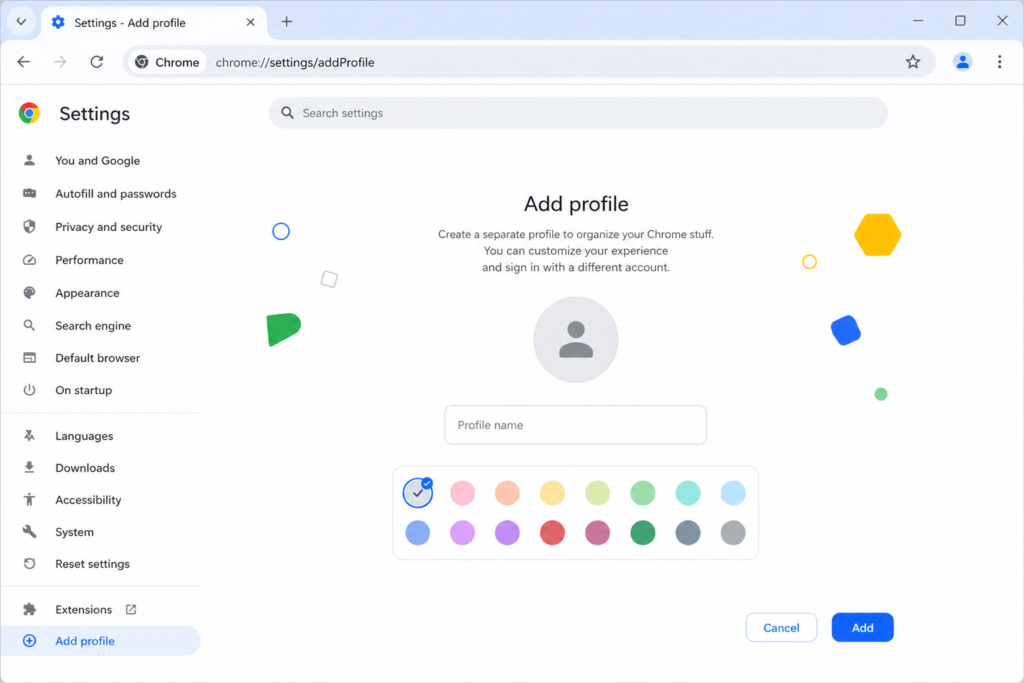
To set one up in Chrome: click your profile icon in the top-right corner of the browser, click “Add,” name it (e.g., “Client A”), and open a new window in that profile. Log into that client’s ActiveCampaign account, and it’ll stay logged in there whenever you open that profile.
It takes about two minutes to set up per client and saves a lot of back-and-forth.
ActiveCampaign Login Security — A Quick Checklist for 2026
Before we move on, here’s a fast rundown of where your account security should stand right now:
- ✅ 2FA enabled using an authenticator app
- ✅ Unique password — 12+ characters, not reused from another platform
- ✅ Password manager in use (Bitwarden, 1Password, or similar)
- ✅ Connected apps reviewed — go to Account Settings and check what third-party apps have access to your account
- ✅ Team member permissions audited — anyone who no longer works with you shouldn’t still have access
- ✅ No public Wi-Fi logins without a VPN running
If you’re on one of ActiveCampaign’s higher-tier plans, you also have access to an audit log that shows every login attempt, the device used, and the IP address. Checking this monthly takes two minutes and can catch something suspicious well before it becomes a real problem.
Related Reading
If you’re building out your SaaS toolkit alongside ActiveCampaign, a few other pieces from this blog are worth your time:
- Monday.com Login: How to Sign In — if you’re using Monday for project management and keep running into login friction there too
- 7 Best SaaS Tools for Startups on a Budget in 2026 — useful if you’re evaluating your full stack and trying to keep costs reasonable
- Campaigner Email Marketing Review — worth a look if you’ve ever wondered how ActiveCampaign stacks up against alternatives
- Email Marketing Updates October 2025 — catches you up on platform changes that may have shifted how things work
To Wrap Up
Getting into ActiveCampaign should take five seconds, not five minutes. With the right setup — SSO if it fits your workflow, 2FA definitely enabled, a solid password, and browser profiles if you’re juggling multiple accounts — login stops being something you even think about.
Quick recap of what actually matters:
- Use SSO if your team runs on Google or Microsoft — it genuinely simplifies things
- Enable 2FA now if you haven’t already — your contact database is worth protecting
- Browser profiles are the cleanest solution for managing multiple accounts
- If something breaks, check the email mismatch and clock sync issues first — they solve 80% of login problems
Now close this tab and go send some emails. Your campaigns aren’t going to build themselves 🙂
Got a login workaround that’s saved you time? Drop it in the comments — always curious what other people have figured out.